Building a Life Might Be Easier Than Enjoying It: Why Success Starts to Feel Empty
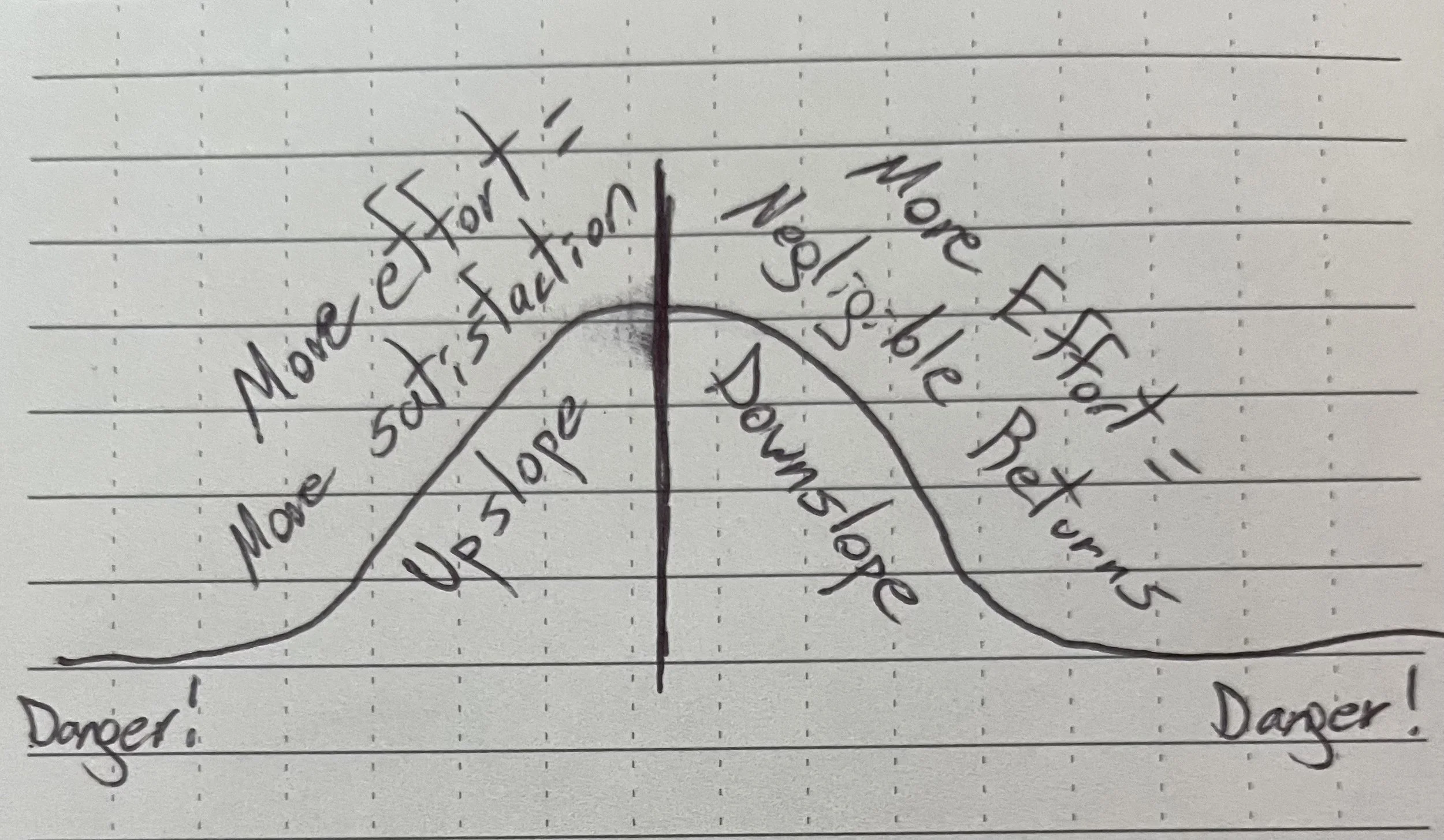
Work hard and then watch out for diminishing returns.
“If we refuse to enter the second adulthood, we will try and relive the first one. We will relapse into a frenetic energy that makes us think that more accomplishment, more success, more change, more recognition will fix the midlife malaise, but alas, we are simply delaying the inevitable.”
- Jon Tyson
One of the most helpful concepts I come back to over the past several years is this idea that life has a first half and second half. As I once heard Jungian psychotherapist James Hollis put it: The first half of life asks what the world requires of me, and the second half of life asks what my soul requires of me.
These “halves” aren’t really halves in the sense that this transition happens when you’re between 35 and 45, halfway through your life. The first half of life is where you use the world’s rules and regulations to survive, make friends, (attempt to) find love, make some money, get a diploma, (attempt to) have some kids, figure out what you believe and stand for, learn how to take care of your health, and provide a life where the bills get paid.
What is the First Half of Life?
My favorite writer, Ronald Rolheiser, explains how essential it is to have some success in this part of your life:
“A healthy self-image isn’t just handed to us on a platter. Part of the task of our youth is to do the kinds of things that not only build up the world, but also help us build up ourselves. One of the lessons in the parable of the talents is that there are penalties too for not being successful.”
The first half of life is about adaptation and comparison. You adapt to your family of origin because you have no agency to change it or leave it. You adapt to trends when puberty hits because of the awful sense of self-consciousness that comes over you and the meanness of middle schoolers who can’t yet handle their new competitive drives with skill and grace. You adapt to your relationship or singleness and to the expectations that come with your particular social group. We get tattoos or we’re clean cut, one kid or four or none, homeschool or public school our kids, banker or entrepreneur, megachurch or small church or no church, conservative or liberal, rubber duckies on our jeep dashboard or a new Hyundai or a re-built Land Cruiser.
Like all of life, it can be a hard season. But it often has an inertia and feels like it’s pulling us through with its expectations and milestones. It hurts when you aren’t checking the boxes that you and your particular culture want you to check, but at least you know what the boxes are. You need to go get a job, find someone to marry, have some kids, have good morals, and save some money.
But this seems to be where the typical life script runs out and the midlife malaise hits. As Dr. Hollis describes it, our psychological road map is exhausted and we don’t feel like there’s anything better on the horizon.
What is the Second Half of Life?
As if going on that first half journey of establishing a life and some belief in your abilities isn’t hard and harsh enough, there’s a transition you have to make just as you’re starting to feel confident. The second half of your life comes after you’ve built something and tasted some success via adaptation to the world and realized that it couldn’t satisfy you - if you’re willing to slow down enough to feel it and admit it. Back to Ronald Rolheiser quoting Karl Rahner: “In the torment of the insufficiency of everything attainable, we learn that ultimately in this world there is no finished symphony.”
Entry into this phase comes through grief and disappointment, and not everyone makes the transition because they keep grasping at distraction, addiction, and something out there that will re-light that flame they felt when they were hitting all of those first half of life milestones. But it’s a match that won’t re-light like it used to. New stuff, a new wife, a degree, an Instagram following, whatever your thing is, will never hit like the first one. And that’s a feature, not a bug. That’s an invitation to depth that many ignore by trying to look and feel young again via running back the first half of life playbook rather than going through the pain of entering the second half that leads to finding joy and letting go of self-consciousness that has been plaguing you and fueling you.
I recently had a very successful person in the middle of this transition to the second half of life ask, “Will I ever feel anything again?” The answer is yes, if you’ll let go of first half of life as the only model.
How do We Transition From First Half of Life To Second Half Without Destroying Our Lives First?
Here’s the question for those of us who have more or less checked several of those first half of life boxes that our circumstances have allowed:
Will you now begin to enjoy it and find meaning in it, or will you continue to try to recapture that first half of life energy and external validation?
Three main tasks stand out to me via reading Rolheiser, Hollis, and Ecclesiastes:
Sort through the traffic of our past and let go of the protections and reflexes that are keeping us from living our life now.
“Sorting and sifting over time leads to discernment. That is what is necessary to find our voice in the midst of the many claims upon us, the collisions of obligations, and the impulsive service to our complexes. And then, as Jung reminded, come the moral qualities. Can I mobilize the courage to face my life, to meet all the challenges that show up, knowing that I am most undermined by the adaptive reflexes within that were once so necessary? Those “protections” are now constrictions in which I am imprisoned by my own past. And then can I live those choices out over time, in the face of consequences, perhaps the loss of understanding and support of loved ones or estrangement from my tribe?”
Hollis, James. Living an Examined Life: Wisdom for the Second Half of the Journey
Stop proving ourselves, learn to bless others, let go of bitterness that plagues us, and become more truly selfless.
“(In the first half of life) We’re making a statement: “I count, I’m worthwhile, I’m talented, I’m good, I’m loveable, notice me, love me.” There’s nothing wrong with that, up to a certain age, it’s how we grow, and the taste of some success is often useful precisely in moving us along towards a purer motivation. But there comes a point when life is no longer about proving ourselves, or anything else. The task now is to become selfless, beyond proving anything, least of all our own worth. A healthy dose of failure is often quite useful in teaching us this. Success always feels good, but at a certain age it no longer works its magic. That doesn’t make it wrong to continue to be successful, it only makes it wrong to need to succeed in order to feel good about ourselves.”
Rolheiser, Ronald. Failure and the Second Half of Life. https://ronrolheiser.com/failure-and-the-second-half-of-life/
Learn how to actually experience this present moment as a gift and stop striving after “gain” that will always slip right through your fingers.
Behold, what I have seen to be good and fitting is to eat and drink and find enjoyment in all the toil with which one toils under the sun the few days of his life that God has given him, for this is his lot. Everyone also to whom God has given wealth and possessions and power to enjoy them, and to accept his lot and rejoice in his toil—this is the gift of God. For he will not much remember the days of his life because God keeps him occupied with joy in his heart. (Ecclesiastes 5:18-20)
“The sixteenth-century Reformer Martin Luther comments, ‘This statement is the interpreter of the entire book.’ Its goal is ‘to forbid vain anxieties, so that we may happily enjoy the things that are present and not care at all about the things that are in the future, lest we permit the present moment, our moment, to slip away.’ The only time you can ever enjoy is now, and in every now God gives you much to enjoy. You might preoccupy yourself with fearful thoughts of the future, bitter thoughts of the past, or bleak thoughts of the present, but if you receive the present as a gift from God, then God fills your heart with joy. The joy God gives now occupies your heart, leaving no room for regret or anxiety to crowd in.”
Jamieson, Bobby. Everything is Never Enough.
Addressing Your Objections
More to come on how we go through each of these transitions, but I want to address two objections in my own mind and experience.
To the high achiever, no, this does not mean giving up on accomplishment. It means moving it down your list of overall life tasks in service of actually enjoying what you’ve accomplished and not having a major crisis later in life when you are no longer the best at everything you do. You can still be great at what you do, but your greatness might actually be capped by trying to re-light that old worn out match over and over. Savor what you’ve done and built and create a tree full of branches of mature others rather than trying to build a tower of yourself.
To the person who feels like they are approaching the second half of life mentality without having fully checked the “boxes” of the first half of life: You need to have exercised as much agency as possible in the first half of life, but you can’t control finding love or having kids or overcoming the limits of disabilities. But it seems that we must all push ourselves to produce as much as we can within our given constraints in order to develop self confidence that allows us to love others without terrible self-consciousness and insecurities getting in the way. But the goodness of the second half of life is not reserved for those of us who check all of the boxes that our particular culture expects. As a matter of fact, your struggles may help you enter into it more fully than I will ever be able to, and you should be our guide.
What Now? What First?
If you haven’t built a life that you’re decently proud of, find a mentor to help you do so. Then get to work on the parts that you have some influence over. But if 10 people with common sense would tell you that you’ve done pretty well for yourself and you have a pretty good life, it might be time to find a second half of life mentor who will help you with perspectives and a lifestyle that allows you to actually enjoy what you’ve built and stop putting out so much effort for diminishing returns. We don’t all need the same prescription.
Either way, put your phone down. Put your phone down and do what you can to build your life a little more. Then put your phone down and enjoy the “lot” God has granted you. Don’t let your moment slip away.